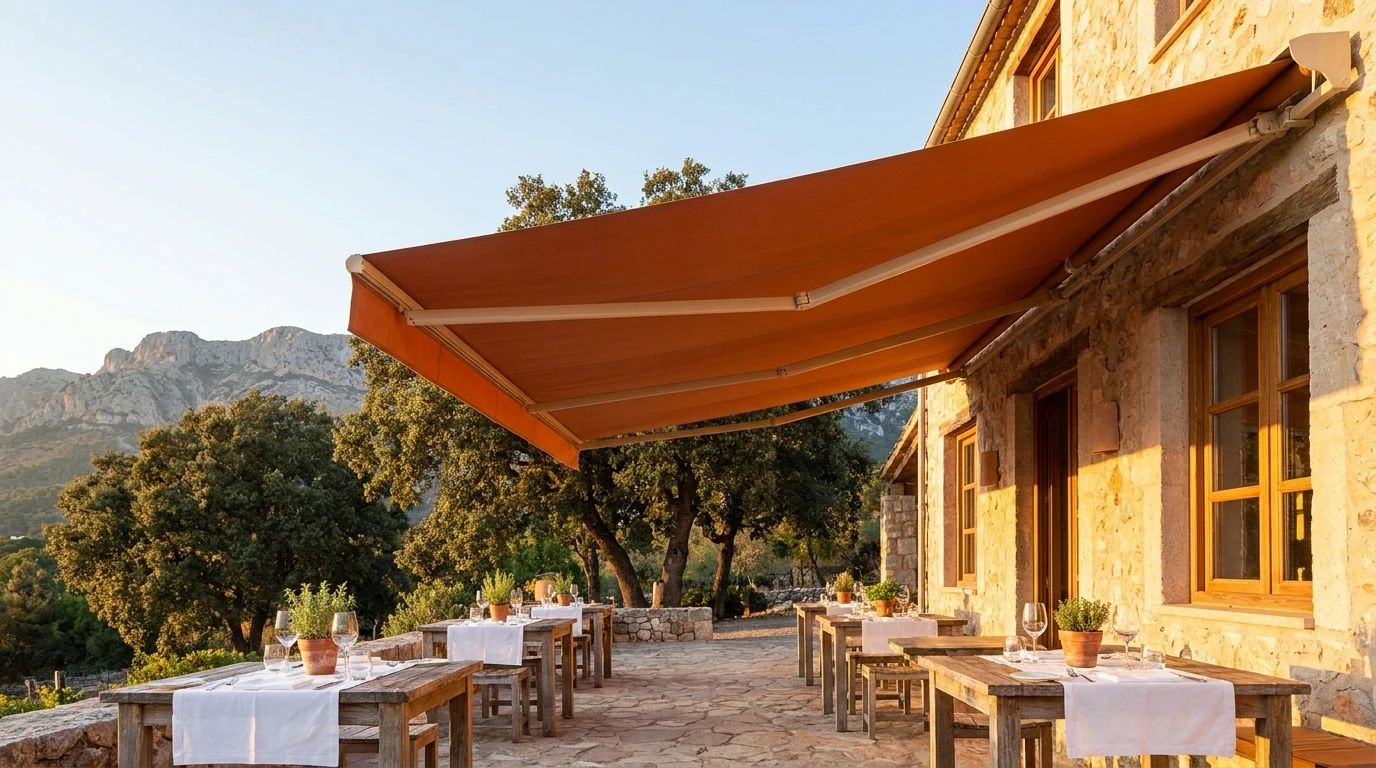
A folding-arm awning turns a baking north- or west-facing terrace back into a usable room through the middle of the day, then retracts to let welcome afternoon sun back through once the worst of the heat has passed. No posts means no interrupted view across a gallery courtyard or vineyard row, and no clutter around a tasting-room entrance or braai corner. Solution-dyed acrylic fabrics hold their colour under the Cape's summer UV, and a full-cassette option seals the fabric and arms away completely between uses.
Franschhoek's valley is a horseshoe closed on three sides by the Franschhoek, Wemmershoek and Groot Drakenstein mountains. As those peaks cool faster than the air above them, the cooled air drains down into the valley most evenings — a predictable event timed to dusk, not a random daytime gust. Every awning we fit here is motorised with a wind sensor that reads that pattern and retracts automatically as the evening drainage sets in, protecting the fabric and arms without you needing to remember to crank it in before you leave the table.
An awning is a shade product, not a rain product — fine at a pitch for light drizzle, never for standing water or a proper storm. Wind ratings are real limits, and the fixing substrate (a solid Cape Dutch wall, a newer timber-frame addition, a steel structure) genuinely changes the install — worth a site assessment rather than a guess from a photograph.
The same evening-drainage wind logic applies whether the terrace sits in the village itself, on a working farmstead in Groot Drakenstein, an orchard smallholding in Simondium, or a golf and wine-estate terrace further out in Paarl — the wind source changes from valley drainage to a mountain-range gust depending on which side of the pass you're on, but the auto-retract requirement doesn't.
Ready when you are
Send the form and one of our expert consultants will contact you shortly to arrange your free in-home measure.
Request my call-back →